Should I build an AI website in 2026?
AI tools can now generate a full website in minutes. That's genuinely impressive. But “generated” and “ready for business” are two very different things. Here's an honest breakdown of what AI can and can't do for your website in 2026.
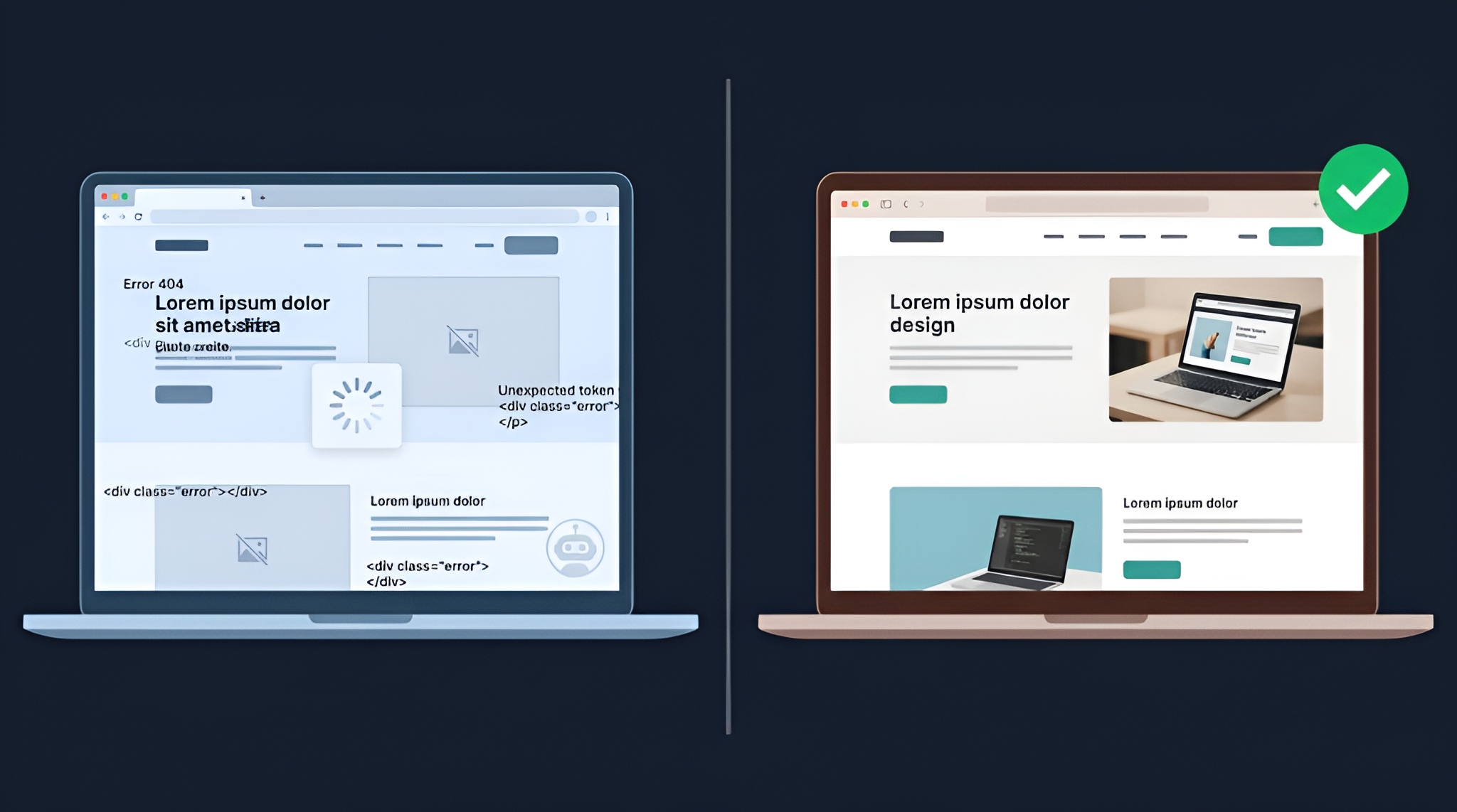
First: yes, you should be using AI
Let's get this out of the way. AI is not a gimmick. Tools like Claude, ChatGPT, and Lovable are genuinely useful, and every business owner should be incorporating them into their workflow in some form. Whether you're using an LLM to draft emails, plan content, handle admin, or prototype ideas, these tools save real time and real money.
You don't need to be a developer. You don't need to be a designer. The barrier to entry for creating things with AI has essentially disappeared. That's a massive shift, and if you're ignoring it, you're leaving an advantage on the table.
The question isn't whether AI is useful. It's whether the website it produces is ready to represent your business.
What AI website builders can actually do in 2026
The current generation of AI tools is impressive. If you open Lovable, Bolt, or ChatGPT and describe the website you want, you'll get something that looks like a real website within minutes. We're talking layouts, colour schemes, navigation, placeholder content, even responsive design that works on mobile. Five years ago, this would have been science fiction.
For prototyping and getting ideas out of your head and onto a screen, these tools are brilliant. You can describe “I want a website for my plumbing business with a dark theme and orange accents” and get something back that genuinely looks the part.
If you just need to see what something could look like, or you want a starting point for a conversation with a developer, AI builders are an excellent place to begin. No argument there.
Where it falls apart
Here's the part that most AI hype articles skip over. Building a website and shipping a website that works for your business are completely different jobs. The gap between “this looks nice on my screen” and “this is live, fast, ranking on Google, and generating enquiries” is enormous. And it's in that gap where most AI-built sites get stuck.
Deployment is still a headache
You've built something in Lovable. It looks great in the preview. Now what? You need to get it onto a real domain, configure DNS, set up hosting, handle SSL certificates, and make sure it actually loads reliably for visitors. For someone without technical experience, this is where the wheels come off.
Some AI builders offer their own hosting, but that means your business website lives on someone else's subdomain or platform that you don't control. If that platform changes its pricing, shuts down, or limits your site, you're stuck. Your business website should live on infrastructure you own and control.
Performance is an afterthought
AI-generated code tends to be verbose. It works, but it's not optimised. You'll often get oversized bundles, uncompressed images, unnecessary JavaScript, and rendering patterns that tank your Core Web Vitals. The site looks fine when you're previewing it on your laptop with fast broadband. Open it on a phone on 4G and the experience is very different.
Google still uses page speed as a ranking factor. A site that scores 40 on PageSpeed Insights is a site that's invisible on Google, regardless of how good it looks.
SEO doesn't happen by accident
An AI builder will give you a page with content on it. What it won't do is build a proper SEO architecture: semantic HTML structure, correct heading hierarchy, meta descriptions tailored to search intent, canonical URLs, structured data for local business schema, XML sitemaps, or internal linking strategies.
These aren't cosmetic details. They're the difference between showing up when someone searches “web design Halifax”and being completely invisible. AI tools don't understand your local market, your competitors, or the specific search terms your customers use. That takes human strategy.
Functionality has limits
AI builders are good at layouts. They're less good at the things that make a business website actually useful:
- Contact forms that reliably deliver emails to your inbox (and don't get flagged as spam)
- Proper form validation that prevents garbage submissions
- Analytics integration so you can track what's working
- Accessibility compliance so your site works for everyone
- Cookie consent that actually meets UK GDPR requirements
- Proper error handling and 404 pages
- Social media meta tags so your site looks right when shared
Each of these sounds minor on its own. Together, they're the difference between a prototype and a professional website.
The “good enough” trap
The most dangerous thing about AI website builders is that the output looks convincing. It's good enough that you think it's ready. You put it live, share the link, and assume the job is done.
Then months pass. No enquiries come in. You don't rank for anything on Google. The contact form doesn't work on certain browsers. The site takes six seconds to load on mobile. A potential customer visits, sees something that looks slightly off, and goes to a competitor instead. You never know it happened.
“Good enough” is the enemy of effective. Your website is often the first impression someone has of your business. If it's 80% there, it feels worse than a site that's obviously amateur, because it creates expectations it can't meet.
The smart approach: build with AI, finish with a developer
Here's the approach that actually makes sense in 2026: use AI to start, use a developer to finish.
Build your prototype in Lovable, Bolt, or whatever tool you like. Get the layout roughed out. Experiment with colours, content structure, and page flow. Use ChatGPT to help write your copy. This is a genuinely productive use of these tools and it saves you money because you're arriving at a developer with a clear vision rather than a vague brief.
Then hand it to someone who can take it from prototype to production. That means:
- Refactoring the code for performance, stripping out the bloat and optimising for speed
- Building proper SEO with structured data, meta tags, sitemaps, and content optimised for your local area
- Setting up reliable hosting on infrastructure you control, with proper DNS, SSL, and CDN configuration
- Adding real functionality like contact forms, analytics, accessibility, and cookie consent that actually work
- Testing everything across devices, browsers, and connection speeds to make sure it performs in the real world
- Deploying properly so your site is live on your domain, fast, and ready to rank
This hybrid approach gives you the speed and creativity of AI with the reliability and polish of professional development. And because you've done the design exploration yourself, the development cost is lower than starting from scratch.
What we do at Webvise
We use AI tools ourselves. Claude Code is part of our daily workflow. We're not anti-AI. We're anti-shipping-half-finished-websites.
If you've built something in an AI tool and want it turned into a proper business website, we can take what you've made and refactor it into a fast, production-ready site built on Next.js. You get the 95+ PageSpeed scores, the local SEO, the reliable functionality, and the professional finish, without paying for the design exploration phase because you've already done it.
If you haven't started yet and want us to handle the whole thing, that works too. Either way, you end up with a site that's fast, ranks, and actually brings in business.
The bottom line
Should you build an AI website in 2026? Yes, as a starting point. AI tools are a brilliant way to prototype, experiment, and get clarity on what you want. Use them. Embrace them. They're not going away.
Should you put an AI-generated website live as your business's online presence without any professional involvement? Probably not. The gap between a generated prototype and a production-ready website is real, and it's exactly where enquiries, rankings, and credibility get lost.
The businesses that will win online in 2026 aren't the ones ignoring AI. They're the ones using it intelligently, as a tool in the process rather than a replacement for the whole thing.
Got an AI-built site that needs the professional treatment? Or want to talk through whether building with AI makes sense for your business? Get in touch. We'll give you an honest answer.
Related posts
Built something with AI? Let's make it production-ready.
We'll take your prototype and turn it into a fast, SEO-optimised site that actually generates enquiries.
Get a Free Quote