One supplier for everything a workplace buys, explained on sixteen pages
Halifax workplace supplies company with eight product categories and a free supplier review enquiry.
- Client
- Supply Hub UK
- Trade
- Workplace supplies
- Based
- Halifax, West Yorkshire
- Live since
- 2026
What the business needed
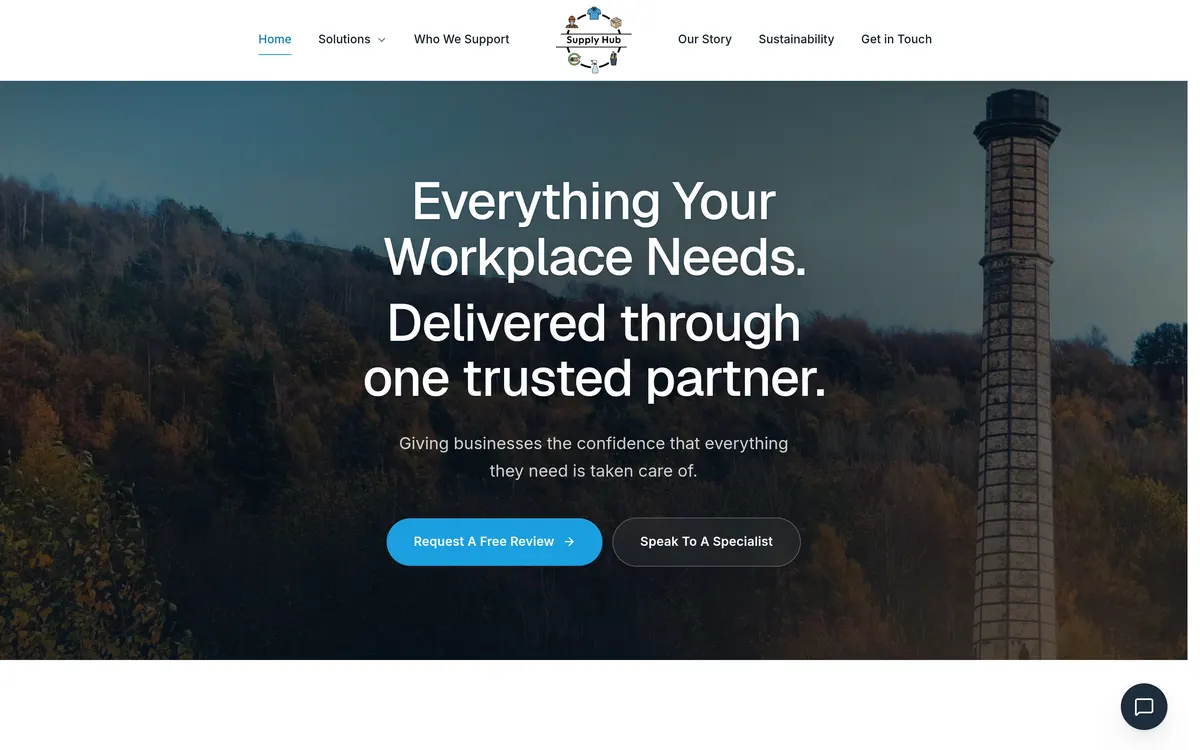
Supply Hub sells office essentials, workwear, PPE, print, packaging, furniture, cleaning and technology to businesses across Yorkshire from an office at the Elsie Whiteley Innovation Centre in Halifax. The pitch is consolidation: one supplier and one invoice instead of eight. The site had to make that case to a buyer who is usually an office manager with a dozen other jobs, and then get them to hand over their current spend for a free review.
The client supplied a written copy deck in July 2026 and wanted it used as written. That is rarer than it sounds and it shaped the whole build: the homepage and all eight solution pages carry the deck verbatim, and when the client later asked for pages they had not yet written copy for, the drafted text was pulled and replaced with obvious placeholder so nothing on the site could be mistaken for approved copy. The drafts were archived rather than deleted, ready for when the client wants to edit them.
What was built
Sixteen routes: the homepage, an index and eight solution pages generated from one typed content module, about, support, sustainability, contact and the legal pages. Every solution page shares a template so the eight categories read as one range rather than eight designs.
The visual system is built in plain CSS rather than a component library: layered shadows, a spring curve on button presses and superellipse corners where the browser supports them. Every decision is documented in the stylesheet with the date and the client feedback that prompted it, so the next person to touch it knows what was deliberate.
Lead capture runs three ways without a server: a contact form and a scripted lead-qualification chatbot both post to Formspark, and phone and email are one tap from the header. The sustainability page publishes no figures at all until the client supplies real ones, on the principle that an unverifiable number on a page about responsibility is worse than none.
Copy deck used verbatim
The homepage and the eight solution pages carry the client's own wording. Pages without approved copy show placeholder rather than agency prose, and the drafts sit in an archive folder for later.
Consent-first analytics and maps
Google Analytics and the Google Maps embed on the contact page render nothing until a visitor opts in. Reject is as easy to click as accept, which is what the ICO actually asks for.
Scripted lead chatbot
A decision-tree widget qualifies the enquiry and posts it to the same form backend, tagged by product category. No AI, no API bill, nothing to break.
Photography cut to size
All service photography was recompressed for the web, from 70MB to 5.6MB, and the logo came down from 4,254 pixels to 600. Large background bands use AVIF with a JPEG fallback.
Getting it found
Organisation and LocalBusiness structured data are generated from one config module, so the business details on the page and in the markup cannot disagree. The launch notes list the exact sixteen routes for the sitemap and the order of go-live steps: remove the pre-launch indexing guard, add robots and sitemap, verify the form end to end, then submit to Search Console.
As of the last launch notes the site still carried its pre-launch noindex tag by design. There are no ranking figures to report here yet, and none are claimed.
Under the hood
What the site runs on. The same approach is described on the service pages it came from.
- Next.js 15, static export
- React 19 and TypeScript
- Tailwind CSS v4
- Formspark forms with honeypot
- Consent-gated GA4 and Maps
- AVIF and JPEG picture sources
- Organisation and LocalBusiness schema
- Static hosting, no server